
The Phoenicia Playhouse - Celebrating 50 Years - in Co-Production with Woodstock Fringe - Celebrating 25 Years - Proudly Presents…
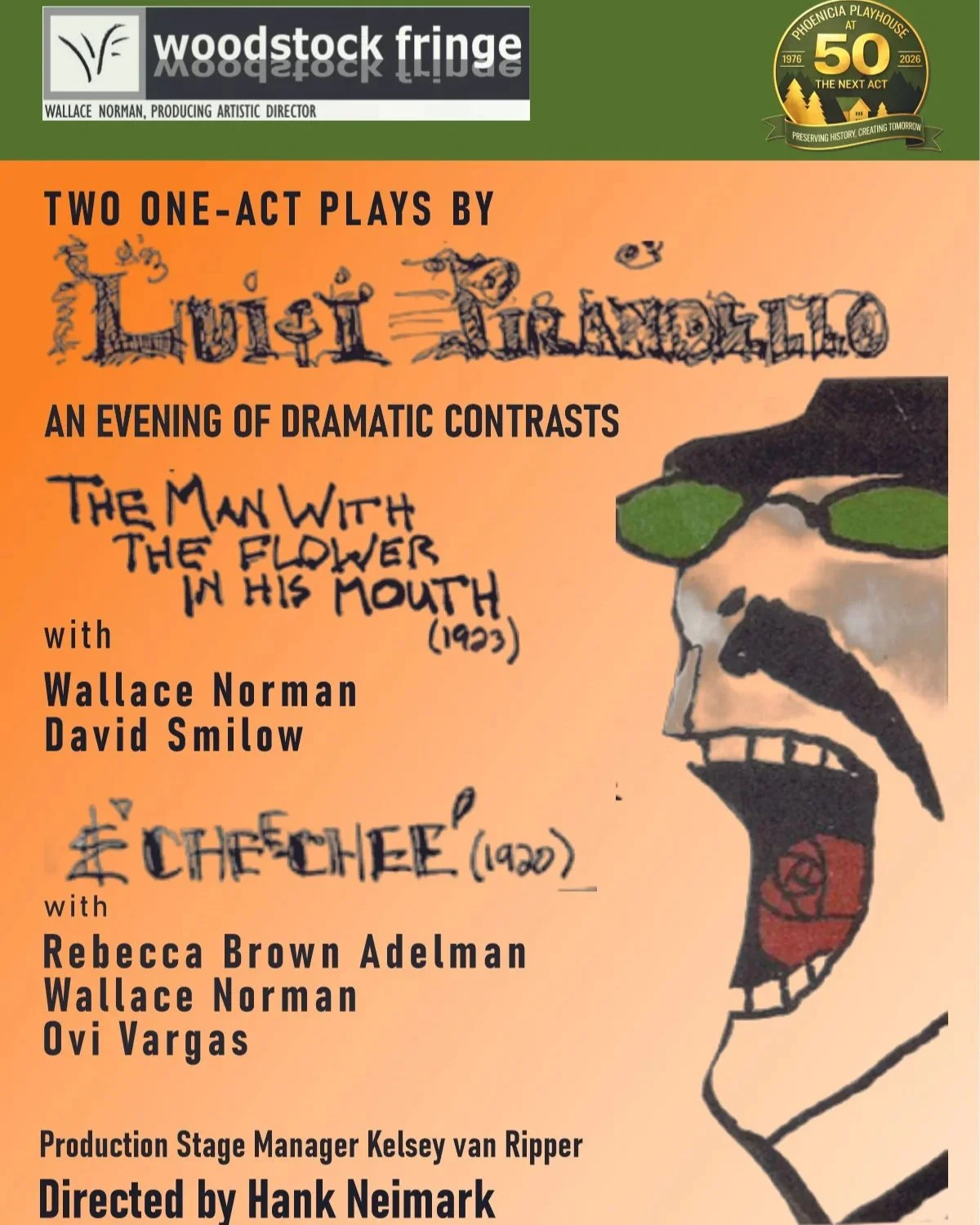
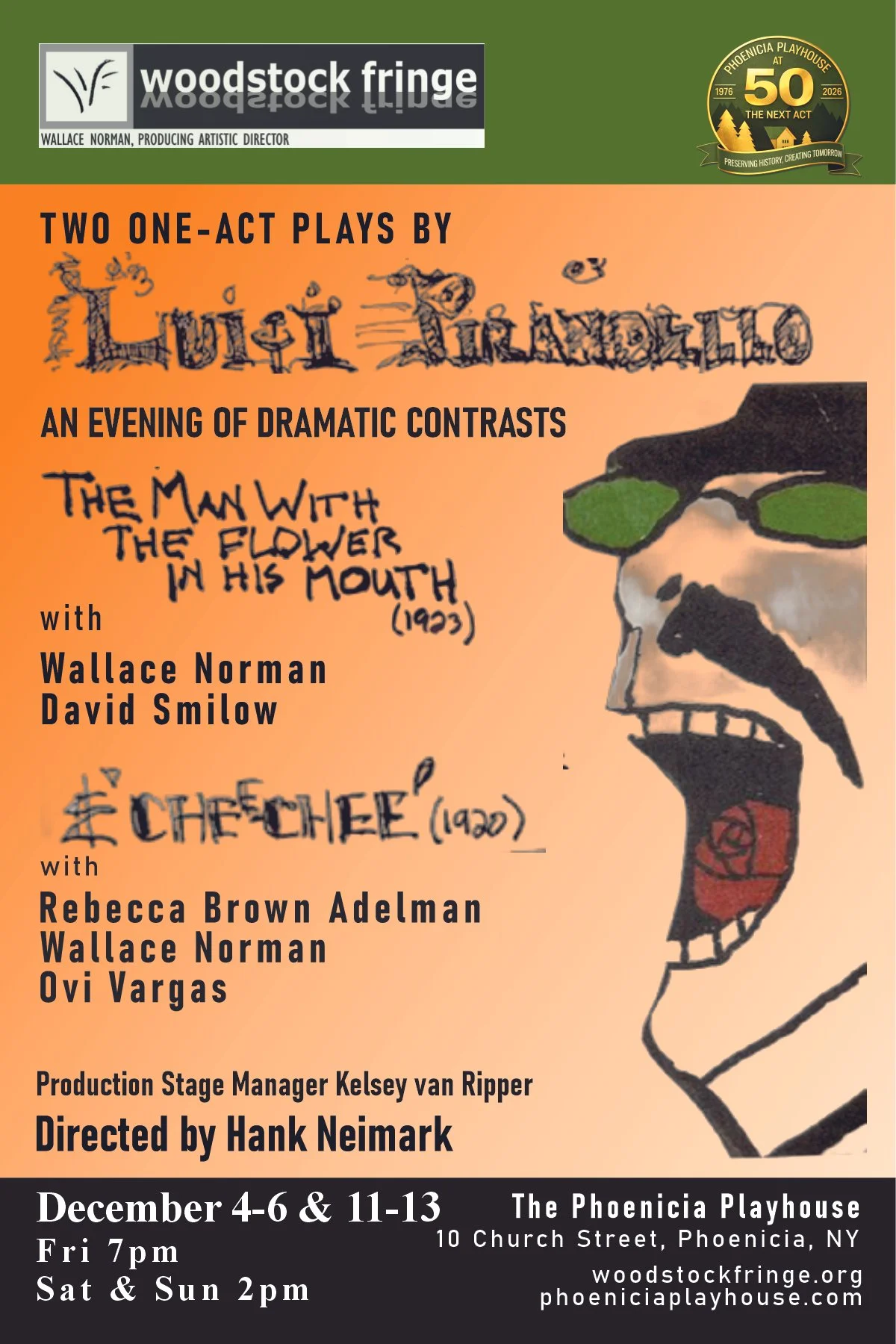
Two One-Act Plays by Pirandello
An Evening of Dramatic Contrasts
The Man With The Flower In His Mouth (1923)
Chee Chee - or Che Cheé (1920)
Directed by Hank Neimark
Two Weekends Only!
December 6th - 13th
Fridays @ 7:00 PM
(Doors Open @ 6:30 PM)
Saturdays & Sundays @ 2:00 PM
(Doors Open @ 1:30 PM)
Tickets:
$25 General Admission
$20 Senior/Student/Veteran
Please be mindful when parking - do not block driveways with your vehicle when parking on Church Street and other nearby streets. Parking on / in front of the vacant lot across from the Playhouse is not allowed by the owner of that property.
Synopses:
The Man With A Flower In His Mouth
CAST:
The Commuter: Wallace Norman
The Man: David Smilow
“It’s the same with men
As with horses and dogs
Nothing wants to die . . . ”
— Tom Waits. The Fall Of Troy
The Man With The Flower In His Mouth is the darker and more contemplative of our two offerings this evening. Two strangers meet in an all-night railway station café, each with his own encumbrance.
It is a brief play but one that resonates with a tenacity that carries it beyond its length.
Within its brevity is a meditation that covers death, perception, observation, and ordinary existence.
CHEE CHEE - or Che Cheé
CAST:
Nada: Rebecca Brown Adelman
Commendatore Squatriglia: Wallace Norman
Chee Cheé: Ovi Vargas
It is difficult to present a synopsis of this little farce without it being a total spoiler, therefore suffice it to say that it is the story of a charismatic Italian playboy, his “girlfriend”, a humble government contractor, and three pesky little IOUs.
About the Playwright:
Luigi Pirandello (1867-1936) was born in Girgenti, Sicily. He studied philology at Rome and at Bonn and wrote a dissertation on the dialect of his native town (1891). From 1897 to 1922 he was professor of aesthetics and stylistics at the Real Istituto di Magistere Femminile at Rome. Pirandello’s work is impressive by its sheer volume. He wrote a great number of novellas which were collected under the title Novelle per un anno (15 vols., 1922-37). Of his six novels the best known are Il fu Mattia Pascal (1904) [The Late Mattia Pascal], I vecchi e i giovani (1913) [The Old and the Young], Si gira (1916) | [Shoot!], and Uno, nessuno e centomila (1926) [One, None, and a Hundred thousand].
But Pirandello’s greatest achievement is in his plays. He wrote a large number of dramas which were published, between 1918 and 1935, under the collective title of Maschere nude [Naked Masks]. The title is programmatic. Pirandello is always preoccupied with the problem of identity. The self exists to him only in relation to others; it consists of changing facets that hide an inscrutable abyss. In a play like Cosí é (se vi pare) (1918) [Right You Are (If You Think You Are)], two people hold contradictory notions about the identity of a third person. The protagonist in Vestire gli ignudi (1923) [To Clothe the Naked] tries to establish her individuality by assuming various identities, which are successively stripped from her; she gradually realizes her true position in the social order and in the end dies «naked», without a social mask, in both her own and her friends’ eyes. Similarly in Enrico IV (1922) [Henry IV] a man supposedly mad imagines that he is a medieval emperor, and his imagination and reality are strangely confused. The conflict between illusion and reality is central in La vita che ti diedi (1924) [The Life I Gave You] in which Anna’s long-lost son returns home and contradicts her mental conception of him. However, his death resolves Anna’s conflict; she clings to illusion rather than to reality. The analysis and dissolution of a unified self are carried to an extreme in Sei personaggi in cerca d’autore (1921) [Six Characters in Search of An Author] where the stage itself, the symbol of appearance versus reality, becomes the setting of the play.
The attitudes expressed in L’Umorismo [Humour], an early essay (1908), are fundamental to all of Pirandello’s plays. His characters attempt to fulfil their self-seeking roles and are defeated by life itself which, always changing, enables them to see their perversity. This is Pirandello’s humour, an irony which arises from the contradictions inherent in life.
Learn More about Woodstock Fringe here:
https://www.woodstockfringe.org
Cast & Director Bios Here:
https://www.woodstockfringe.org/new-page-pirandello-creative-team


